 Calculator guide
Life Path Number Calculator Guide: Inputs, Reduction, and Limits
Use a life path number calculator with correct birth date inputs, clear reduction rules, and realistic interpretation limits.
A life path number calculator needs the complete birth date and a stated reduction method. The result is a reflection framework, not a fixed personality verdict.
Basic Facts and Quick reference
| Check | Why it matters |
|---|---|
| Full birth date | Month, day, and year are the inputs used by the common life path calculation. |
| Reduction method | Different traditions handle compound numbers and master numbers differently. |
| Interpretation boundary | A number can suggest a theme for reflection, but it cannot prove a destiny or outcome. |
What the calculation is using
Searchers use the phrase life path number calculator for several related tasks. One reader expects a simple calculation, another wants an explanation, and another wants a longer report. This guide treats life path number calculator as the calculation-and-method question, while the calculator page handles the interactive input. That distinction helps a life path number calculator page remain useful without pretending the number is a complete reading.
The basic input is a calendar birth date. Most calculators ask for the month, day, and year because the three parts are added together before the result is reduced. The date is not a personality description by itself. It is the starting point for a symbolic calculation that a reader may use as a prompt for reflection.
Use the date exactly as it is recorded. A regional date format can create confusion when a day and month are reversed, and a missing year changes the total completely. If the calculator accepts a date picker, check the displayed value before pressing the result button. If it accepts typed text, use a consistent format and compare the field with the original record.
A good guide also distinguishes a life path calculation from other number systems. A birthday number, name number, destiny number, personal year, and compatibility result may use different inputs. They should not be mixed together simply because they all appear on a numerology site.
Choosing a life path number calculator
A life path number calculator should explain the input before it shows a result. The most useful life path number calculator pages make the birth-date field clear, state whether master numbers are preserved, and give the reader a way to review the calculation.
When comparing a life path number calculator with another tool, check the method before comparing the wording. A life path number calculator that uses a different reduction rule may produce a different number without either tool being technically broken.
Choose a life path number calculator that keeps the result connected to the original date. A transparent life path number calculator should let the reader see what was entered, what rule was used, and where to read the related explanation.
If a life path number calculator gives a dramatic promise or presents one number as a complete identity, treat that as a quality warning. A responsible life path number calculator is more modest: it describes a theme, explains the boundary, and points to a practical next question.
How reduction rules work
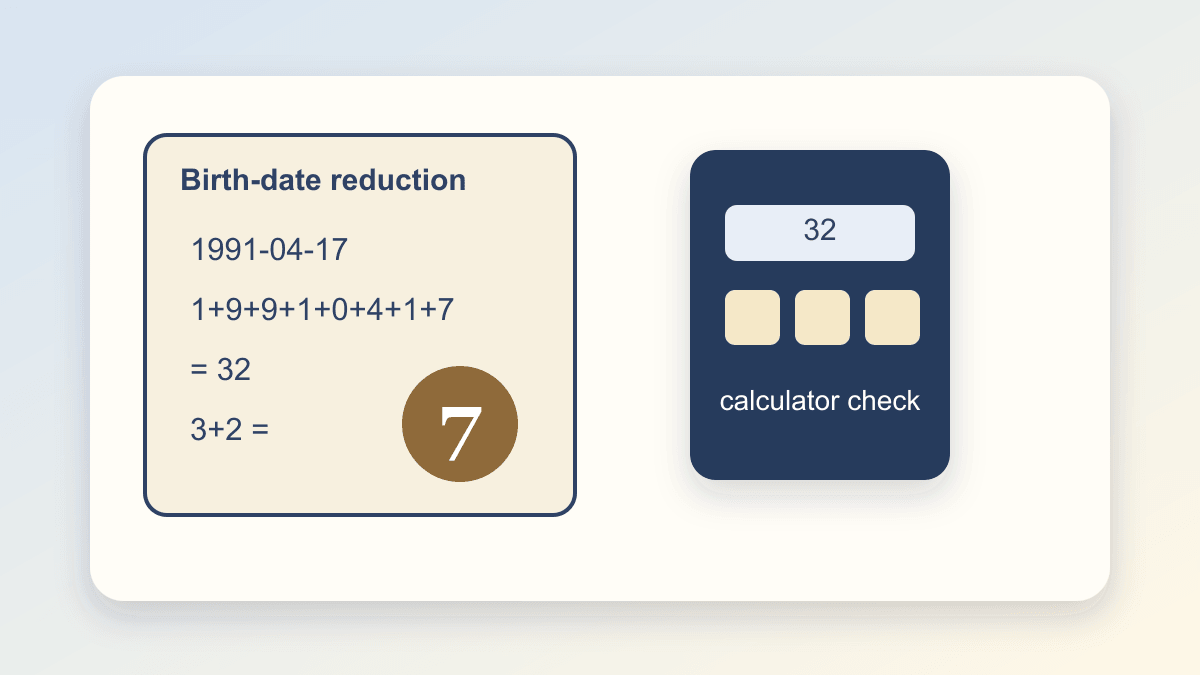
Many numerology methods add the digits in the birth date and continue reducing the total until a core number remains. For example, a multi-digit total may be added again so that the final result falls within the usual single-digit range. The exact presentation can vary, but the page should show enough of the method for a reader to understand where the result came from.
Some traditions preserve master numbers such as 11, 22, or 33 when they appear at a relevant step. Other systems reduce every compound number. Neither choice should be hidden. If two calculators show different results, compare their reduction rules before assuming that one of them is broken. A difference in method is often more important than the number itself.
When comparing results, record three things: the original birth date, the intermediate total, and the rule used for the final reduction. This small record makes the calculation auditable and prevents a later interpretation from becoming detached from the input.
Read the result as a theme
A life path result can be used as a broad theme such as initiative, cooperation, expression, structure, change, care, analysis, management, or completion. These descriptions are intentionally broad. They are most useful when they give a reader a question to consider rather than a label to obey.
Compare the suggested theme with real behavior and current circumstances. If a description seems accurate, write down one concrete example and one counterexample. If it does not fit, do not force the story to fit. Personal history, culture, education, health, relationships, work, and choices remain more direct explanations of what a person does than a symbolic number.
The same result can feel different at different times. Someone may use a life path theme to reflect on study habits one month and on work boundaries the next. That change does not mean the number predicted an event. It means the reader brought a different question to the same symbolic framework.

Compare the result with the right page
Use the life path calculator when the question begins with a birth date and a broad personal theme. Use a name numerology calculator when the question is about spelling or a chosen name. Use a personal year calculator when the reader wants a calendar-year reflection. Use a compatibility calculator when two people or two birth dates are being compared.
The page should route the reader to the correct next step instead of treating one calculation as a complete numerology profile. A chart page can help compare several number types, while a report page can organize a result into longer notes and reflection prompts. The route should follow the question, not push every visitor toward the same product.
Common input mistakes
- Using only the birth year when the method expects the full date.
- Reversing the day and month because the date format was unclear.
- Reducing a master number without checking the stated method.
- Comparing a life path result with a name number as if they measured the same thing.
- Copying a result without saving the input and calculation rule.
- Treating a symbolic description as proof of a future event or fixed identity.
These mistakes are easy to prevent with a short checklist. Verify the date, read the method note, save the intermediate result, and keep the interpretation provisional. The goal is not to make a symbolic system sound more certain; the goal is to make the reader understand what the tool actually did.
Why calculators can disagree
Two life path tools can disagree for ordinary reasons. One may preserve a master number while the other reduces it. One may add the month, day, and year as separate parts while another adds every digit in one sequence. A display can also round or label an intermediate value differently. Before treating the difference as a meaningful sign, compare the input format and the calculation notes.
When you want a result that can be reviewed, save a short record with the date, the intermediate total, the final reduction, and the method name. This makes it possible to repeat the calculation without relying on memory. It also gives a report or guide a clear source for its explanation. A transparent result is more useful than a dramatic result that cannot be checked.
It is also normal for a reader to prefer one method for cultural or personal reasons. The important boundary is to name the choice. Do not present one tradition as the only valid system, and do not use a disagreement between methods to create fear or pressure. The calculator is a way to organize a question; the reader still decides how much weight the question deserves.
Use the result responsibly
Numerology can be used as cultural or personal reflection, journaling language, or a way to organize questions. It should not replace medical, mental-health, legal, financial, safety, or relationship advice. A result cannot diagnose a condition, guarantee a business outcome, decide whether someone is trustworthy, or determine whether a major life choice is safe.
For a practical reading, write one sentence that connects the theme to a real situation and one action that can be reviewed later. For example, a reader might use a communication theme to plan a conversation or use a structure theme to organize a study schedule. The action should be useful even if the symbolic interpretation is set aside.
What to do next
Start with the free life path calculator, confirm the displayed birth date, and read the result alongside the method above. If you need a broader comparison, open the numerology chart guide. If you want to understand the report format before deciding, review the numerology reports page.
A useful review also separates the calculation from the decision that follows. If the result is being used for a name choice, a relationship question, a work plan, or a purchase, write down the practical evidence separately. That separation keeps the number in its proper role and makes the final choice easier to explain later.
This simple separation is especially useful when several calculators are open at once. Keep each result labeled by its input and method so a life path number is not accidentally reported as a name or personal-year number.
Use this life path number calculator guide before opening any life path number calculator so the input, method, and interpretation boundary are clear.
FAQ
What should I check first in a life path number calculator?
Use the complete birth date and confirm the reduction method before reading the result.
Are master numbers handled the same way everywhere?
No. Some systems preserve 11, 22, or 33 while others reduce them, so the method should be stated clearly.
Is a life path number a fixed destiny?
No. Use the result as a reflection prompt rather than a fixed identity label or prediction.
For broader background, see the Wikipedia overview of numerology.